Welcome! We are making significant changes to our product line and have paused all new orders until our transition is complete.

Green Tea

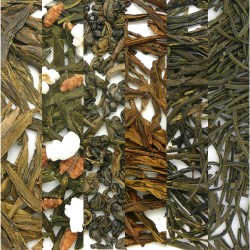
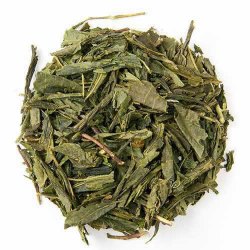
When you sip green tea, you are drinking tea as it has been consumed for thousands of years. The leaves are prepared in a way that captures the color, scents, and vibrancy of those freshly plucked from the bush.

Green tea is an unoxidized tea. The leaves are processed very quickly so they do not have the chance to brown, retaining the initial essence of these wondrous leaves. Some green teas are covered by shade for a few days to weeks before plucking yielding more vegetal flavors in the finished tea.

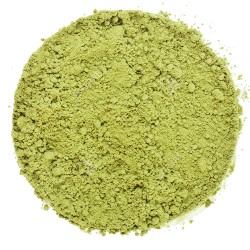
The tea is most famously made in China and Japan. Chinese greens tend to be lighter and less intense than Japanese greens. They have a slight sweetness to them. Japanese greens are more vegetal in character. A famous form of Japanese green tea is matcha, a steamed green tea whose leaves are ground to a fine powder. This is the tea traditionally used in Japanese tea ceremonies.

There are a number of other countries that also produce green tea. Korea and Taiwan have been producing it for generations. More recently, we are seeing green teas produced in India, Bolivia, Vietnam, and even in Hawaii (such as our Kilinoe tea)!

Processing Green Tea

These are the steps of green tea production:

Plucking

Green tea leaves are usually picked first thing in the morning. The leaves are placed in baskets or bags that allow for a great deal of air circulation, keeping the leaves cool and preventing oxidation.

Sorting and Cleaning

Twigs, stems, and rocks are removed and the leaves are separated by size.

Withering

For some green teas, there is a short period of drying. This step is skipped for many green teas.

Heating

This heating "fixes" the chlorophyll, keeping the leaves green. It also destroys the enzymes that would cause oxidation. Japanese green tea processing uses steam for this purpose. Chinese green tea manufacturers generally uses a pan-firing process on a hot wok or hot air.

Rolling and Drying

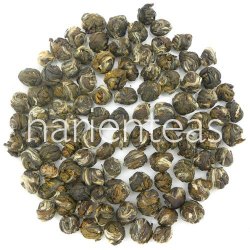
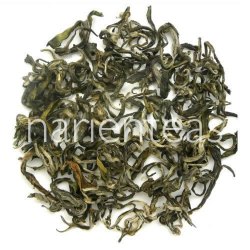
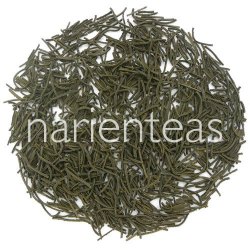
The leaves are dried and rolled into the appropriate forms for the type of green tea being created. The leaves may be sun dried, basket dried on bamboo over charcoal embers, pan fired over a hammered wok-like pan, tumble-dried in a metal drum, or oven-dried or steamed on a conveyor belt. Rolling and shaping also differs depending upon the country's traditions. In China, green tea might be shaped into many forms: pellets, spirals, or twists for example. In Japan, nearly all of the tea is prepared using a "Sencha" roll where the leaves are shaped and broken into slender needle shapes.

Finishing

Some Japanese green teas such as Gyokuro and Matcha are ground at this point. Others such as Hojicha are roasted.

Green Tea History

China has been producing green teas for 5,000 years. While the very first teas were simply leaves placed in boiling water, green tea processes evolved over the years to produce teas that were highly prized. Green tea was brought to Japan from China by monks who became enamored with it during their studies. They valued it for its ability to keep them awake and alert during their lengthy meditations.

Green Tea Types

Japanese green teas are graded differently from Chinese green teas. There are four grades of Japanese green tea:

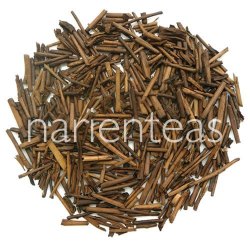
Kukicha

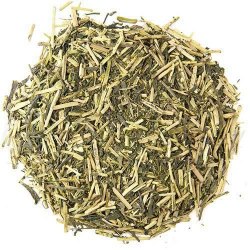
This is the last flush (growth) of tea and includes stems. It has a woody, nutty flavor.

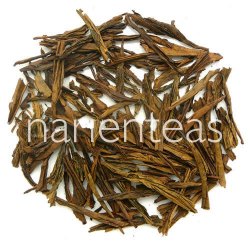
Bancha

These are older leaves, usually the 3rd of 4th flush.

Sencha

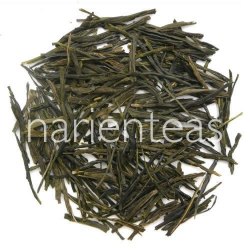
These leaves, meaning "precious dew," are smaller, more tender early leaves from the 1st or 2nd flush. This is the most popular grade in Japan.

Gyokuro

Gyokuro or "Pearl Dew" is considered the best grade. These leaves are shaded for up to 3 weeks before harvest to increase their chlorophyll, making them a more vibrant green.

Chinese teas are graded based on the age of the leaf, the way they are prepared, and the shape of the leaf. Some of the major grades are:

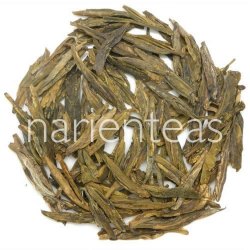
Dragonwell

Broad, flat leaves

Gunpowder

Leaves are rolled into pellet shapes.

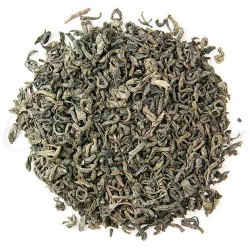
Young Hyson

Long and twisted or thinly rolled leaves.

Imperial

Large, loosely rounded older leaves

Hyson

Smaller, older version of Young Hyson.

Twankey

Old, ragged leaves of inferior quality

Dust

Brewing Green Tea

Some people think that they do not like green tea because they have only consumed poorly brewed greens. Green tea steeped in boiling water will be stewed and taste bitter. It is particularly important to be careful with time and temperature.

Green teas are best brewed between 160 to 190 degrees.

Chinese green teas like our Dragonwell or Gunpowder are best brewed at about 175 degrees F for 2 - 3 minutes. The tea liquor will range from a pale yellow green to a pale green.

Japanese green teas like our Sencha or Gyokuro Asahi brew to much more intense green liquors. They should be brewed on the lower end of the temperature scale and usually 1 - 2 minutes is sufficient.

Green Tea Flavors

Chinese greens are known for tasting more mild than Japanese greens. Because the heating and drying process is slower for Chinese teas the leaves tend to be a bit sweeter and more aromatic. Flavors characteristic of Chinese green teas include sweet, chestnuts, orchids, green beans, honey, and cooked carrots. Japanese greens are described as having flavors that are grassy, marine or kelpy, vegetal, hay-like, asparagus, spinach, or mineral for example.

Green Tea Caffeine

The caffeine content of teas depends upon many factors: the cultivar of the tea plant, the age of the leaf being picked, and where on the stem the leaf is located, how long it is oxidized, leaf size, how much leaf is used, the temperature of brewing, and how long the tea steeps.

Studies have shown that one pound of tea leaves has more caffeine than one pound of coffee. However, it takes less tea than coffee to brew a cup. Therefore, there is actually 50-65% less caffeine in a cup of tea than in a cup of coffee. Plus, the way the caffeine is absorbed is different. With tea, the caffeine is absorbed more gradually so you tend not to get the big caffeine burst nor the caffeine crash.

Because green teas are generally brewed at cooler temperatures with shorter steep times, their caffeine content would be lower than some other teas. Some suggest that green tea has caffeine of about 1/3 that of black tea and probably 1/4 of that in a cup of coffee.

Pagerank Button